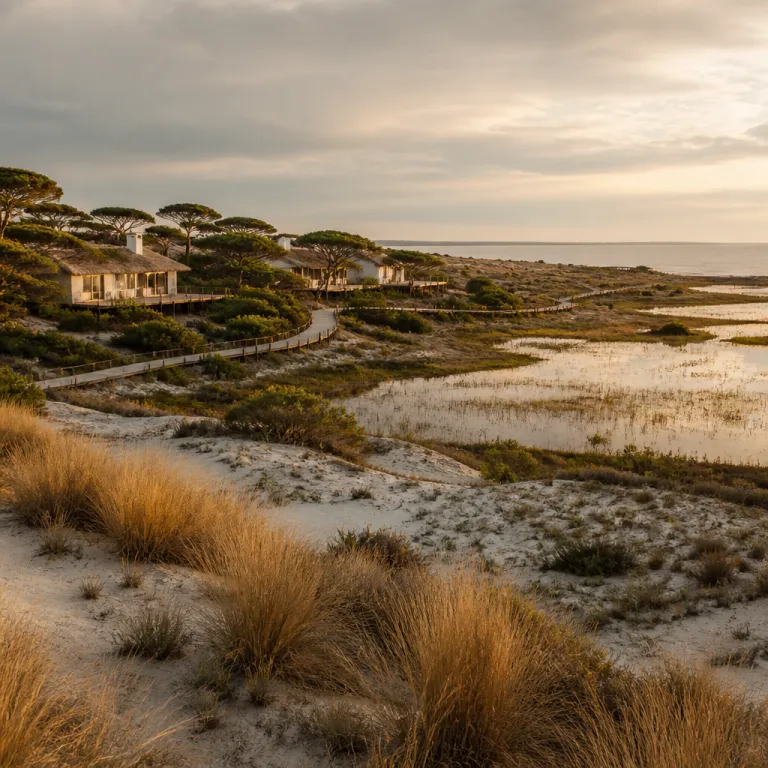
Na Praia hotel Comporta as a new coastal benchmark
Na Praia hotel Comporta sits on a quiet peninsula between the Atlantic and a protected nature reserve, reshaping how luxury feels on this stretch of the Alentejo coast. The scale is unapologetically ambitious for Portugal, with 113 keys spread across 42 rooms, 3 suites, 63 houses and 5 villas, yet the layout keeps guests close to nature rather than to corridors. This is not a hotel that hides its size; instead, it uses the land to create distance, silence and a rare sense of place.
The property occupies 340 hectares of coastal terrain, but only 100 hectares are developed while 240 hectares remain untouched dunes, pine forest and wetlands. That conservation-first decision underpins the entire project and will appeal to travelers who want beach access and design without sacrificing the landscape they came for. Cars are parked at the perimeter, so the central spine of rooms, suites, houses and villas stays car free, and guests move through the sand on foot, by bike or in quiet electric buggies.
From a booking perspective, Na Praia hotel Comporta gives couples and families an unusual range of configurations, from compact rooms and suites to multi bedroom houses and villas with private pools. The suites and houses are arranged to frame the Atlantic rather than the parking, while the villas sit closer to the nature reserve and the Sado estuary wetlands. For travelers comparing hotels in Comporta, this mix of hotel rooms, suites, houses and villas on one continuous beach-facing site is precisely what makes Na Praia feel like a coastal village rather than a single hotel block.
Studio KO’s architecture, dunes and a car free heart
Studio KO’s architecture at Na Praia hotel Comporta is deliberately recessive, with low slung volumes that curve into the dunes instead of standing above them. The buildings are pulled apart into clusters, so guests always see sand, rice fields or the Atlantic between structures, never a wall of concrete. This approach to architecture is closer to a dispersed monte estate than to a conventional beach resort, and it changes how you move through the property.
Materials stay rigorously local and natural, from limewashed walls to timber screens and stone that echoes the wider Alentejo and the Atlantic coastline. Landscape architects Doxiadis+ stitch the built areas back into the nature reserve with native grasses and low shrubs, so paths feel like they have always been there. At night, low level lighting protects the dark sky and the dunes, while still giving guests enough guidance to walk from rooms and suites to the restaurants barefoot.
The car free core is more than an aesthetic gesture; it shapes the daily rhythm of guests and their experiences. Families with children can let them roam between the beach, the pools and the central square without crossing traffic, while couples can walk from their suites and houses to the Atlantic in silence. According to early design presentations shared by the development team, the aim is “to make the sound of the ocean louder than the sound of engines,” a principle that guides both the masterplan and the way guests circulate through the site.
Conservation first luxury and the Na Praia ecosystem
The owners position Na Praia hotel Comporta as a conservation first luxury model, and the numbers are unusually clear for a coastal project. Out of 340 hectares on the peninsula, only 100 hectares are built, leaving 240 hectares as a living buffer of dunes, pine forest, rice fields and wetlands that connect to the wider Sado estuary system. According to preliminary planning documents and early developer briefings, a resident biologist programme is planned to monitor birdlife, dune stability and water quality, turning the property into a low key field station as much as a hotel.
Methods include sustainable construction, the use of local materials and traditional techniques that suit this part of Portugal rather than fight it. Cars remain at the edge of the site, energy systems are designed to reduce demand, and the landscape team works with the natural topography instead of flattening it, which protects both the dunes and the sense of place. For guests, this translates into quieter nights, more wildlife sightings and a stronger feeling that the beach around them will look the same when they return.
The conservation bet also extends to food and operations, with the culinary team sourcing from nearby rice fields, the Sado estuary fisheries and small farms inland toward São Lourenço and the montado. Five restaurants led by a Portuguese chef focus on local produce rather than imported luxury, echoing the region’s shift toward sustainable, terroir driven hospitality seen in projects like the restored monastery at Vila Viçosa, covered in our analysis of heritage five star openings in the Alentejo. For travelers used to urban luxury in Lisbon, this is a different proposition entirely; the luxury is the silence, the dunes and the Atlantic horizon, not a skyline.
How Na Praia sits among Comporta’s leading hotels
For years, Sublime Comporta has been the shorthand for high end stays in this part of Portugal, with its pine framed pool, scattered cabanas and, more recently, a wave of new villas and a BeefBar outpost. Casas Na Areia set the original barefoot tone, with sand floors and minimal design that made Comporta feel like a secret, while Vermelho Melides, Christian Louboutin’s Relais & Châteaux project down the coast, brought maximalist color and village scale glamour. Na Praia hotel Comporta enters this landscape with a different brief; it is larger, more infrastructural and more explicitly tied to conservation.
Where Sublime Comporta spreads through the forest inland, Na Praia stretches along the shoreline itself, with direct beach access and long views over the Atlantic and the Sado estuary. Casas Na Areia remains intimate and almost experimental, but Na Praia offers a full spectrum of rooms, suites, houses and villas, making it easier for extended families or groups of friends to stay together without losing privacy. Vermelho Melides leans into crafted eccentricity and village life, while Na Praia’s design language by Studio KO is quieter, more about texture, shadow and the way buildings sink into the dunes.
In regional terms, Na Praia also signals that the Alentejo coast is no longer a side note to Lisbon but a destination with its own cluster of leading hotels. For travelers planning a wider itinerary, it now makes sense to pair a few nights at Na Praia with inland stays around São Lourenço or the cork country, using resources like our cork to cellar sustainable route from Évora to understand how the coast connects to the interior. The result is a more layered trip, where a day on the beach at Comporta sits alongside tastings in the montado and slow lunches in whitewashed villages.
Access, infrastructure and what this means for future stays
Comporta has always been reached by a single main road from Lisbon, a drive of roughly ninety minutes that threads past rice fields, cork oaks and the Sado estuary. As Na Praia hotel Comporta opens with 113 keys and other hotels expand, the question is whether that road, and the small villages around Carvalhal and Praia Comporta, can absorb the extra traffic. The decision to keep Na Praia’s core car free is one answer, but it does not change the fact that every guest still arrives by car or transfer.
Once on site, the experience shifts gear; cars stay at the perimeter, and guests move through the dunes and natural corridors on foot or by bike, which keeps the central area quiet. For couples, this means evenings walking from their suites and houses to the restaurants under a dark sky, hearing the Atlantic rather than engines, while families can let children cycle between pools and the beach with fewer worries. Local residents and planners have also raised broader questions about seasonal congestion, public transport and housing pressure, so Na Praia’s long term impact will depend on how regional infrastructure and community consultation evolve alongside the resort.
For travelers weighing whether to book Na Praia or one of the smaller hotels, the decision comes down to how they want to experience this stretch of the Atlantic coastline. Those who value a wide choice of dining, structured experiences and a village like grid of rooms, suites, houses and villas will gravitate toward Na Praia, while others may prefer the seclusion of a single farmhouse or a smaller property inland. Either way, the arrival of Na Praia hotel Comporta marks a turning point; it shows that large scale development on this beach can be tied to architecture, nature and conservation rather than to sprawl.
FAQ
What is Na Praia and where is it located ?
Na Praia is a luxury hotel in Comporta, Portugal. It sits on a 340 hectare peninsula in the Alentejo region, between the Atlantic Ocean and a protected nature reserve near the Sado estuary. The address places guests within easy reach of Praia Comporta, Carvalhal and the wider Atlantic coastline.
Who designed Na Praia and how is it built ?
Na Praia was designed by Studio KO, with landscape architecture by Doxiadis+. The project uses sustainable construction methods, local materials and traditional building techniques to minimise environmental impact on the dunes and surrounding nature. Buildings are low and dispersed, so they blend into the sand and vegetation rather than dominate the beach.
When is Na Praia opening and how many accommodations are available ?
The hotel is scheduled to open in spring 2026 and is planned with 113 keys in total, according to early project announcements and local planning submissions. Guests can choose between 42 rooms, 3 suites, 63 houses and 5 villas, giving options for couples, families and larger groups. This mix of rooms, suites, houses and villas allows both short stays and longer, more residential experiences.
What makes Na Praia different from other hotels in Comporta ?
Na Praia stands out for its conservation first model, with only 100 of 340 hectares developed and the rest kept as dunes, forest and wetlands. Cars are parked at the perimeter, creating a car free core that feels closer to a coastal village than a conventional resort. Compared with Sublime Comporta, Casas Na Areia or Vermelho Melides, Na Praia offers a larger scale, direct beach access and a stronger emphasis on environmental monitoring through a planned resident biologist programme.
How does Na Praia balance luxury with environmental preservation ?
The hotel combines high end hospitality with strict limits on land use, energy demand and lighting, protecting both the dunes and the night sky. Food sourcing focuses on nearby rice fields, the Sado estuary and local farms, reducing transport and supporting regional producers. Prospective guests should note that details such as the exact opening date, key count and biologist programme are based on current project information and may evolve as Na Praia moves toward completion.